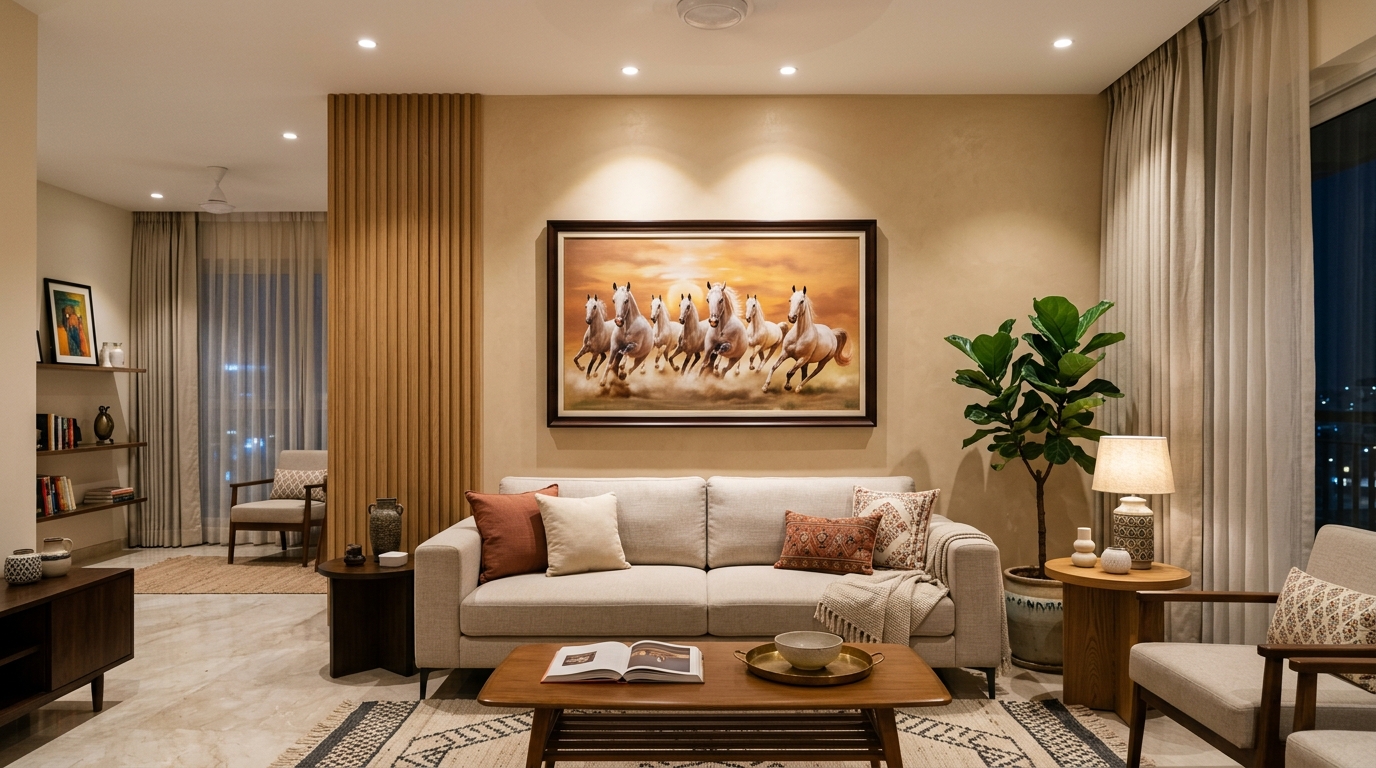

Most apartment floor plans in Mumbai, Bengaluru, or Delhi give you between 600 and 1,200 square feet to balance work, family, and daily routines. When you want to set up a dedicated prayer corner, you rarely have the luxury of a separate, windowed room.
What usually happens instead is an awkward compromise. A heavy, carved wooden temple unit gets jammed into a passage, blocking a doorway. Or worse, sacred items end up scattered on top of an entertainment unit right next to the router and dangling TV cables.
A modern home mandir does not require a dedicated room or ornate marble carvings. It requires clear spatial math: knowing your seated eye level, protecting your walls from oil smoke, hiding everyday clutter, and choosing materials that hold up against daily heat and water.
Here is how to design an uncluttered, practical pooja space that fits naturally into a contemporary Indian apartment.
1. Ergonomics First: Seated Eye Level and Wall Heights
Before picking timber finishes or CNC patterns, decide how you actually pray.
Do you sit on a floor mat (asana) every morning, or do you stand for a quick two-minute prayer before leaving for work? Your answer dictates the exact installation height of the altar shelf:
- If you sit on the floor: The altar shelf should sit 32 to 36 inches (80 to 90 cm) from the finished floor level. This places the murtis directly at eye level when you are seated crossed-legged, preventing neck strain.
- If you stand: Mount the shelf between 48 and 54 inches (120 to 135 cm) from the floor. The flame of your diya should sit just below your chest line so you are looking slightly downward with respect.
- Depth allowance: A compact mandir ledge only needs to be 10 to 14 inches deep. Anything deeper becomes a dust trap in the back corners. Anything shallower than 9 inches makes it easy to accidentally knock over an oil lamp when offering flowers.
Leave at least 22 inches of vertical clearance between your primary diya and any wooden cabinet or ceiling above it. The rising heat from daily brass lamps can dry out and scorch laminate finishes within months.

2. Three Compact Layouts for City Apartments
Depending on where you have unused wall surface, here are three layouts that keep foot traffic clear:
The Floating Wall Niche (Best for 1BHKs and Studios)
Instead of buying a boxy wooden temple that rests on the floor, mount a floating ledge flush against the wall. A 24-inch wide by 12-inch deep floating shelf takes zero floor space.
If you want visual privacy when guests visit, add folding double doors with laser-cut geometric jali panels. The perforations allow air to circulate so incense smoke does not get trapped inside, while keeping the interior private when closed.
The Ribbed Wood Partition Screen (Best for Open Living Rooms)
In modern open-plan flats where the living and dining rooms blend together, placing an altar against an exposed wall can feel vulnerable.
A floor-to-ceiling slatted partition made of vertical wooden louvers (spaced 1.5 inches apart) creates an intimate prayer zone without cutting off natural light or airflow. Fasten the altar ledge directly to the living-room-facing side of the screen, or tuck it into the alcove behind.
The Converted Corner Ledge (Best for Rental Homes)
Renters often cannot drill heavy anchor bolts into RCC columns. An L-shaped corner floating unit uses two adjacent walls for weight distribution, requiring only standard wall plugs.
Corner setups are naturally sheltered from corridor drafts, which stops diya flames from flickering or blowing out prematurely.
3. Dealing With Soot, Heat, and Water
The biggest frustration homeowners report after six months with a new mandir is soot damage. Sesame oil, mustard oil, and pure cow ghee produce fine carbon particles that cling to porous surfaces. Over time, warm white walls turn gray, and light veneers develop greasy dark rings.
You can prevent this entirely at the design stage by choosing the right materials for the contact zones:
- The altar top: Avoid raw softwood or plain paper laminates. Instead, use an 8 mm slab of white composite marble, nano-white quartz, or solid Corian. These stones do not absorb oil drips and wipe clean with a damp microfiber cloth and a drop of liquid soap.
- The back panel: If you place your diya against a wall, back the niche with a toughened fluted glass panel or a solid brass sheet. Both resist high temperatures and can be degreased in seconds without stripping paint.
- Incense ash protection: Keep a small rectangular soapstone or slate tray under your agarbatti stand. Falling hot ash leaves permanent burn pits on acrylic and PVC sheets.
If you are displaying metal deities, review our brass vs copper puja idols care guide to understand which cleaning solutions keep brass gleaming without dulling delicate stone countertops.
4. Clutter Control: The Hidden Drawer Rule
A sacred space loses its calm the moment it becomes a dumping ground for half-empty matchboxes, torn plastic incense packets, extra wicks, and sticky oil bottles.
The simplest rule for a clean mandir is separating what you venerate from what you use to venerate:
- The Altar Surface: Strictly reserved for 1 to 3 primary murtis, a diya, fresh flowers, and a small water cup (achamana patra). If you have larger collections of sacred artifacts or geometric wall accents, browse our home spiritual decor collection for pieces that hang flat without eating horizontal ledge space.
- The Concealed Drawer: Build a shallow, push-to-open drawer directly underneath the floating shelf (3 to 4 inches deep is ideal). Store your dhoop cups, camphor tabs, wick boxes, and brass polish inside. Because it has no external protruding handles, the unit looks like a sleek architectural block.

5. Lighting: Ditch Harsh Blue LEDs
Nothing ruins the atmosphere of a home altar faster than harsh, cool-white LED strips (6500K) that look like hospital corridor lighting.
A sacred space needs warm, indirect illumination that creates depth and soft shadows:
- Color temperature: Stick strictly to 2700K to 3000K (Warm White). This replicates the golden spectrum of an actual flame and flatters brass, copper, and warm wood grains.
- COB strip lights over individual LEDs: Standard SMD strip lights cast visible, dotted reflections on polished stone. Use continuous COB (Chip-on-Board) LED strips recessed into an aluminum channel with a frosted diffuser.
- Concealed cove placement: Run the light channel vertically behind a wooden false border, or tuck it underneath the front lip of the altar shelf so the source of light remains invisible.
- Switch placement: Do not put the switch inside the temple cabinet where you have to reach past an open flame. Wire the switch to an easily reachable external wall plate at hip height.
6. Curating Murtis Without Overcrowding
It is common in Indian homes to accumulate dozens of framed photos, clay idols from festivals, and souvenirs from pilgrimage trips over years. When 25 different figures fight for space on a 2-foot shelf, cleaning becomes a two-hour ordeal and the altar looks chaotic.
Select one or two focal deities that hold personal significance for your family. If you are selecting a new murti and unsure about proportions, reading how to choose an idol for a home altar will help you pick an idol scale (generally 2.5 to 5 inches for apartments) that balances well with compact shelves.
Place taller items toward the back corners, keep the central sightline open for your primary deity, and let the brass diya sit front and center on a heat-safe runner.
7. Direction and Practical Vastu for Apartments
Traditional Vastu texts recommend the Northeast (Ishan Kona) as the optimal zone for prayer and meditation because it catches the earliest morning light.
However, in modern apartment towers, the Northeast corner might be your master bathroom or a utility balcony. If that is the case, do not panic or break walls.
- Primary alternatives: East and North are equally sound directions for daily prayer.
- Orientation: What matters most is that you face East or North while praying, and that the space is quiet, clean, and away from immediate kitchen grease or laundry piles.
- Never locate the altar: Sharing a common wall with a bathroom, directly under an overhead beam, or inside a master bedroom facing the foot of the bed.
If your layout is awkward or you are trying to balance multiple astrological preferences across family members, speaking with the AstroJi spiritual consultation team can help clarify layout questions before you commit to custom carpentry.
Daily Care Keeps the Design Working
Even the best architectural design falls apart without a simple maintenance habit.
Spend two minutes every evening clearing spent flower petals and wiping oil splatter with a designated cotton cloth. Polish your brass lamps every fortnight with a light lemon-salt rub or brass cleaner, rinse them thoroughly, and dry them before placing them back on the stone.
When every object has a designated home and surfaces are built to handle real heat and smoke, your home mandir remains what it was intended to be: a quiet, grounding space in the middle of a noisy city.
Found this guide helpful?
Share it with friends and family embarking on their spiritual journey.
AstroJi Editorial Team
Verified SpecialistHome & Sacred Space Specialist
Dedicated to dispelling myths and delivering lab-certified clarity on spiritual products for seekers nationwide.