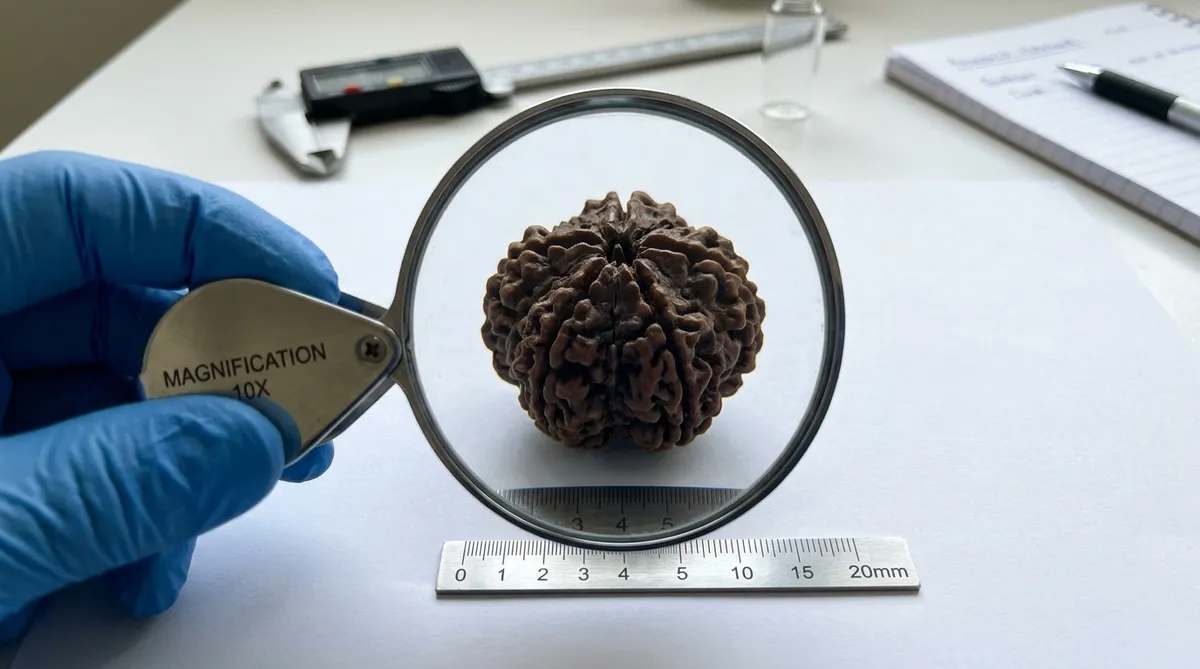
Reading Mukhi lines on a Rudraksha bead requires understanding the natural botanical growth pattern of the Elaeocarpus ganitrus fruit seed. A Mukhi line is an organic structural groove running along the hard exterior shell, corresponding directly to an internal seed chamber.
Botanical anatomy of a natural Mukhi line
In natural trees, the fruit seed forms distinct longitudinal clefts during seed development within the blue outer fruit husk.
- Top to Bottom Trajectory: Authentic Mukhi lines originate at the top pedicel stem attachment point and run smoothly down to the bottom crown without sharp breaks.
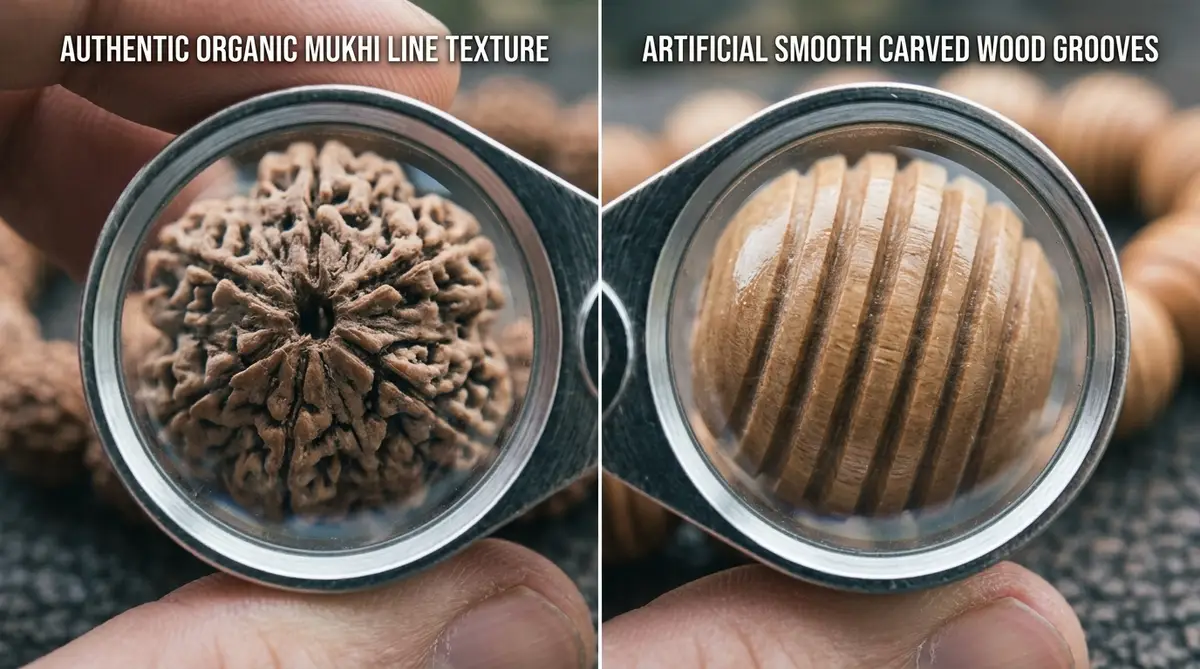
- Organic Texture: Natural grooves feature uneven thorny projections along their inner walls rather than smooth cut surfaces.
- Continuity: Each line remains unbroken from top to bottom. If a line disappears halfway down the bead surface, it represents a surface scratch rather than a true Mukhi groove.
Step-by-step loupe inspection procedure
To inspect a bead accurately at home or before purchasing online:
1. Use a 10x jeweler loupe or high-resolution smartphone macro camera lens under direct bright daylight or LED workbench lighting. 2. Trace each groove individually from the top stem down to the bottom base. 3. Check for smooth flat cuts or sharp right-angle scratch marks. Carved or fake lines made with rotary dental drills have clean parallel walls lacking natural woody thorns. 4. Inspect the pedicel joint. Scammers carve lines into common 5-Mukhi beads to fake rare 6-Mukhi or 7-Mukhi varieties. Carved lines stop short 1mm before the top stem rather than fusing organically into the joint.
Verifying internal locules with X-Ray scans
For high-value beads, physical line counting must match internal seed anatomy.
An X-Ray radiograph scan reveals the internal seed cavities (locules) and seed embryos inside the hard wood endocarp. The number of internal seed chambers must equal the external Mukhi line count. If a bead displays 7 external lines but only 5 internal locules on the X-Ray scan, two external lines were artificially carved into the wood.
You can browse natural Rudraksha beads, view explore authentic Rudraksha malas, or consult specialists at contact AstroJi support.
Found this guide helpful?
Share it with friends and family embarking on their spiritual journey.
AstroJi Editorial Team
Verified SpecialistBotanical & Gemological Specialist
Dedicated to dispelling myths and delivering lab-certified clarity on spiritual products for seekers nationwide.