First-time buyers searching for authentic Rudraksha beads frequently fall for aggressive marketing tactics, fake authenticity tests, and misleading product descriptions. Knowing what to inspect prevents spending money on tampered or counterfeit beads.
Mistake 1: Relying on copper coin or water float tests
Many online videos claim that placing a Rudraksha bead between two copper coins proves authenticity if the bead spins. This is a physics myth.
Movement between copper coins happens because of electromagnetic induction from fingertip moisture and subtle micro-pressure on rounded surfaces. Plain wooden beads, carved Areca nuts, and plastic replicas rotate under the exact same coin setup. Similarly, water floating tests fail because immature genuine seeds can float while heavy carved wooden fakes sink.
Mistake 2: Ignoring carved lines and glued Mukhis
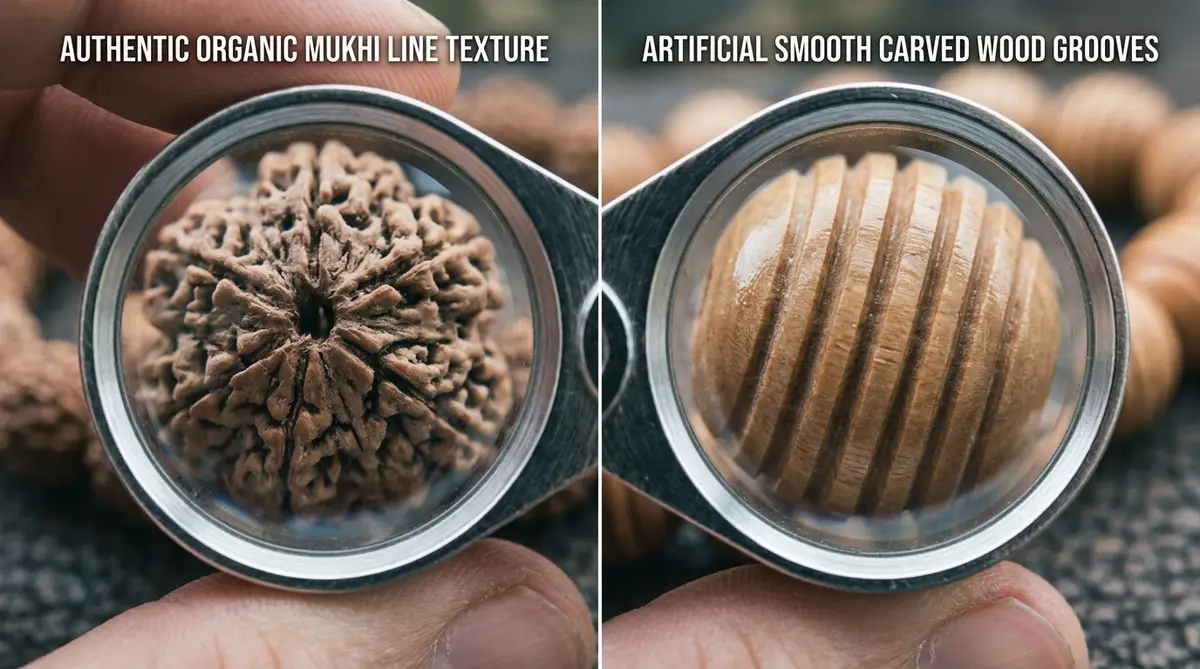
Scammers alter common 5-Mukhi beads by carving extra lines with dental drills to sell them as rare 7-Mukhi, 10-Mukhi, or 14-Mukhi beads.
- Inspect Mukhi line grooves under a 10x jeweler loupe. Genuine lines show organic thorny texture along the edges. Carved lines have smooth, flat cuts with microscopic tool scratches.
- Check line origin and termination. Natural lines originate at the top pedicel stem and run continuously down to the bottom crown without sharp breaks.
- Beware of composite glued beads. Fraudulent sellers glue parts of two lower-Mukhi beads together to fabricate rare shapes like 1-Mukhi round beads.
Mistake 3: Buying high-value beads without X-Ray lab reports
Never purchase high-value beads (such as 1-Mukhi, 7-Mukhi, or 14-Mukhi) without an independent ISO-certified gemological laboratory card.
An authentic lab report includes an X-Ray radiograph scan showing internal seed chambers (locules). The number of internal seed cavities must equal the external Mukhi count. The report must also state exact bead weight in grams and millimeter dimensions.
You can browse certified Rudraksha beads, view explore natural Rudraksha malas, or verify details with contact AstroJi support.
Found this guide helpful?
Share it with friends and family embarking on their spiritual journey.
AstroJi Editorial Team
Verified SpecialistGemological & Authenticity Researcher
Dedicated to dispelling myths and delivering lab-certified clarity on spiritual products for seekers nationwide.